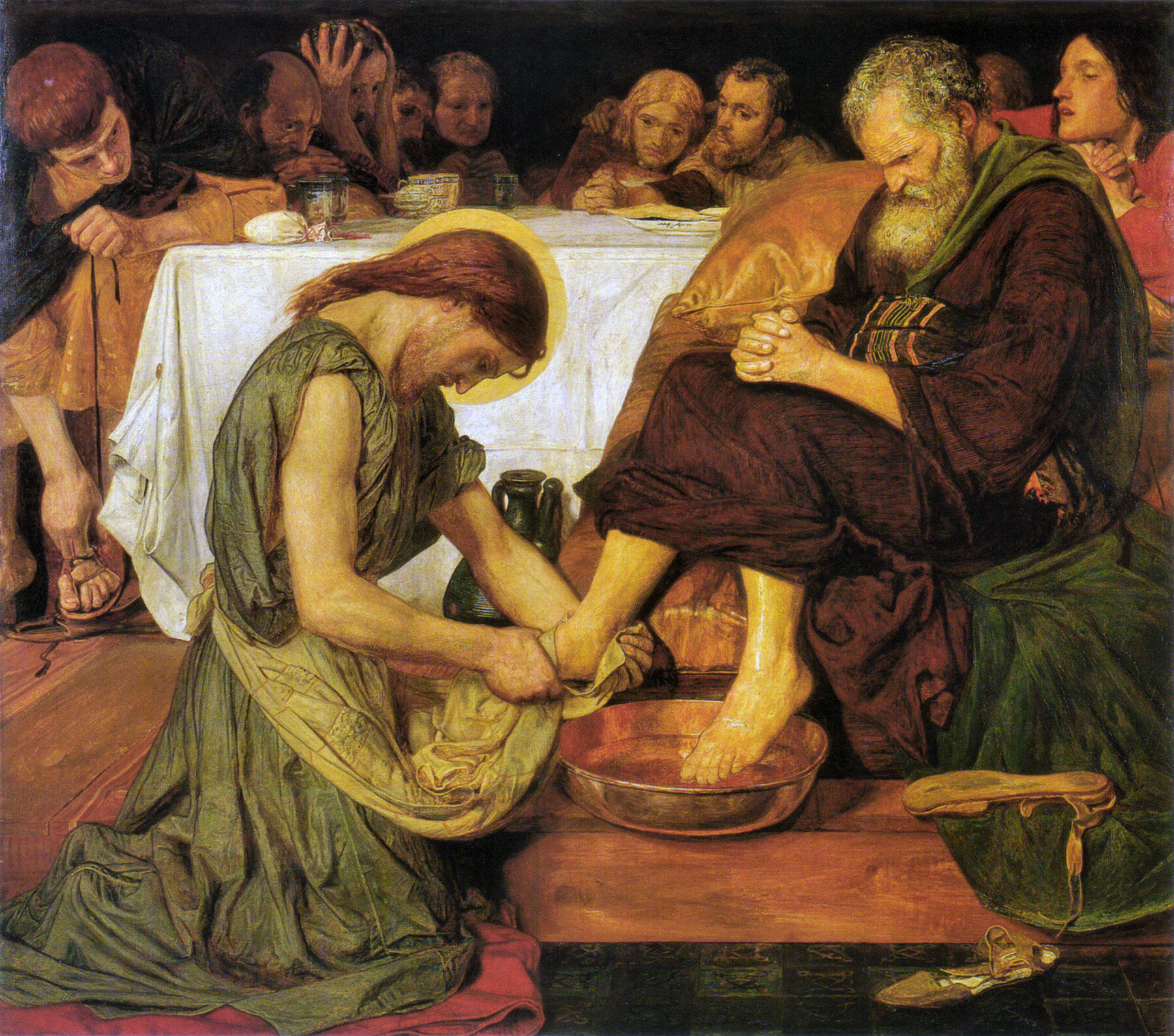
1Now before the feast of the passover, when Jesus knew that his hour was come that he should depart out of this world unto the Father, having loved his own which were in the world, he loved them unto the end.
2And supper being ended, the devil having now put into the heart of Judas Iscariot, Simon’s son, to betray him;
3Jesus knowing that the Father had given all things into his hands, and that he was come from God, and went to God;
4He riseth from supper, and laid aside his garments; and took a towel, and girded himself.
5After that he poureth water into a bason, and began to wash the disciples’ feet, and to wipe them with the towel wherewith he was girded.
6Then cometh he to Simon Peter: and Peter saith unto him, Lord, dost thou wash my feet?
7Jesus answered and said unto him, What I do thou knowest not now; but thou shalt know hereafter.
8Peter saith unto him, Thou shalt never wash my feet. Jesus answered him, If I wash thee not, thou hast no part with me.
9Simon Peter saith unto him, Lord, not my feet only, but also my hands and my head.
10Jesus saith to him, He that is washed needeth not save to wash his feet, but is clean every whit: and ye are clean, but not all.
11For he knew who should betray him; therefore said he, Ye are not all clean.
12So after he had washed their feet, and had taken his garments, and was set down again, he said unto them, Know ye what I have done to you?
13Ye call me Master and Lord: and ye say well; for so I am.
14If I then, your Lord and Master, have washed your feet; ye also ought to wash one another’s feet.
15For I have given you an example, that ye should do as I have done to you.
16Verily, verily, I say unto you, The servant is not greater than his lord; neither he that is sent greater than he that sent him.
17If ye know these things, happy are ye if ye do them.
Historical contextFoot-washing was the lowest slave’s job
In the ancient Near East and the Greco-Roman world, people wore open sandals (or went barefoot) on unpaved roads that were dusty in dry season and muddy in wet — and the same roads carried animal dung. Arriving at a home for a meal, where diners reclined with their feet extended away from the low table (so everyone’s feet were near the next person’s face), meant your feet needed washing. Providing water was a basic duty of hospitality (Genesis 18:4; 19:2; 24:32; Luke 7:44), and in a household with servants, the actual washing fell to the lowest-ranking slave in the house.
Several strands of evidence show just how far down the ladder this task sat:
- The Hebrew-slave exemption Rabbinic tradition held that a Jewish master could not compel a fellow-Israelite bondservant to perform the most degrading menial services — and washing the master’s feet is listed among them (the tradition attached to “you shall not make him serve as a slave,” Leviticus 25:39, developed in the Mekhilta and related halakhic material). The task was considered so demeaning that it was regarded as fit only for a Gentile (Canaanite) slave, not a Hebrew one. That distinction is precisely what makes it “the work of a slave” in the fullest sense.
- The disciple/servant boundary A well-known rabbinic saying (b. Ketubbot 96a) is that a disciple should do for his teacher everything a slave does for his master except undo his sandal-thong — the one act too servile even for a devoted student. Loosing the sandal and washing the foot belong to the same bottom category; recall John the Baptist saying he is unworthy even to untie Jesus’ sandal (John 1:27).
The detail in verse 4What “girding himself” meant
The clothing detail is not incidental — it’s part of the servant costume:
- The long robe had to be dealt with People wore a long, loose outer garment (tunic/robe) that would drag and get in the way of any physical labor. To work, you pulled the hem up and tucked/tied it at the waist with a belt or cloth — “girding the loins” (Exodus 12:11; 1 Kings 18:46; 1 Peter 1:13). Girding = getting ready to work or serve.
- John says Jesus went further In John 13:4 he “laid aside his garments” (removed the outer robe) and girded himself with a towel (Greek lention, a linen cloth). This is the recognized dress of a serving slave: a slave waiting at table or attending his master stood girded with a linen apron/cloth around the waist. By stripping to the tunic and tying on the cloth, Jesus deliberately put on the uniform of a household slave, not just an improvised bib. The single towel then served double duty — as the apron (girdle) and as the cloth to wipe the feet dry (v. 5).